AI systems engineering & real-world cross-border entrepreneurship case studies. Technical deep dives and actionable business playbooks.
Internet Companies Will Design AI Agents the Way They Designed Feeds: Path Dependence in Agent Product Design
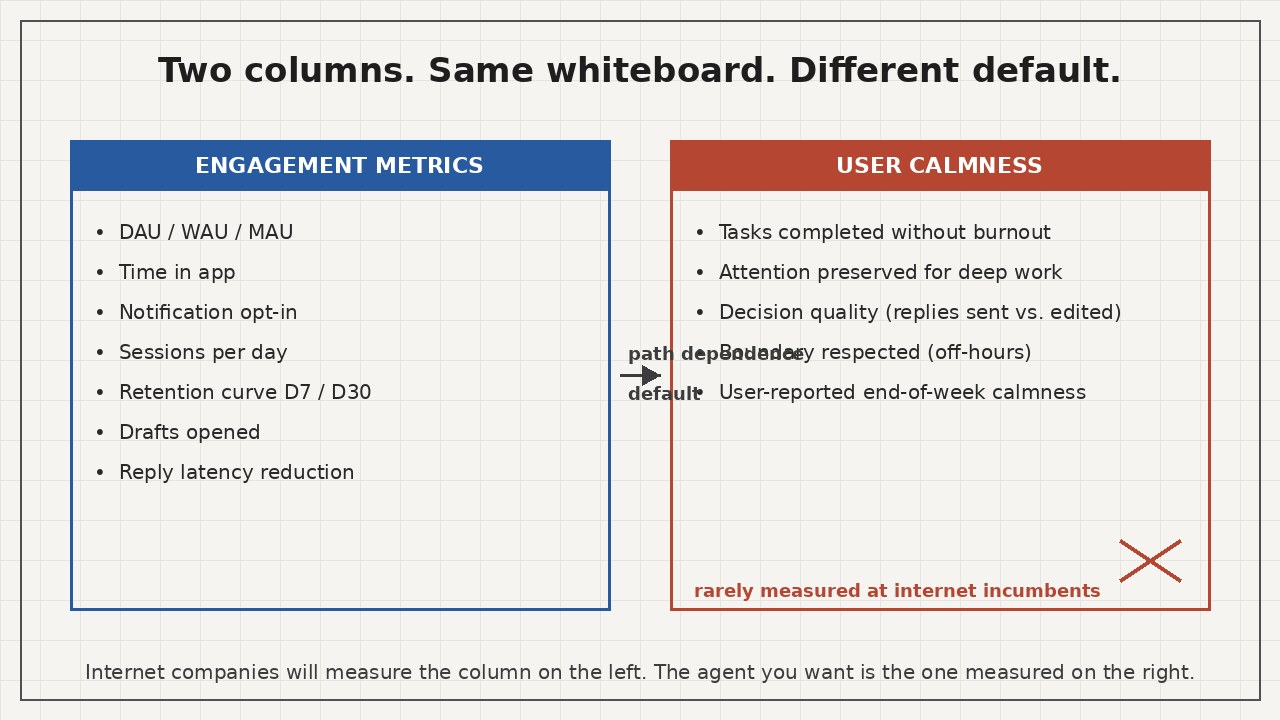
TL;DR A few weeks ago I wrote about the structural shape of inbox-native agents vs. Chrome extensions. That post asked what shapes of agent exist and which one fits which workload. This post asks a different question: who is building these agents, and what organizational baggage will they ship by default? My answer, after a half-year running two agent products in production next to incumbents in the same space, is uncomfortable: internet companies will design AI agents the way they designed feeds — open loops, growth metrics, attention capture — because the org, the dashboards, and the muscle memory are the same. The agent you want (calm, draft-only, guardrail-first) is the one built by a team that was never paid to capture your attention. The agent you will be offered is the one built by a team that always was. The difference is not the technology. The difference is the org chart. ...

Inbox-Native Agent vs Chrome Extension: When to Build Which
TL;DR I built a Chrome extension for cross-border sourcing, then built an inbox-native AI agent next to it. After 6 months running both in production, the Chrome extension wins for real-time page-anchored research (the 45-second sidebar loop), and the inbox agent wins for relationship-driven work (the 5-year email memory data flywheel). The pattern: the extension is the daytime tool, the inbox agent is the always-on tool. If you build only one, build the inbox agent first — its value compounds with every email it reads. ...

MTA Explained: Routing, Queues, Cold-Outreach Deliverability
TL;DR A mail transfer agent (MTA) is the server software that moves email from sender to recipient across SMTP hops — the layer where queue policy, retry logic, throttling, and authentication decide whether your message reaches the inbox or quietly collapses to spam. Most foreign-trade teams below 50,000 messages per month should start with a managed cloud relay (SES, Postmark, Mailgun, Resend) and move to self-hosted Postfix or Exim only when they hit a compliance wall, a deliverability ceiling, or a volume tier where the per-message cost crosses a clear threshold. Treat deliverability as a CI problem: per-domain pacing, 72-hour retry cap, 5 soft bounces in 7 days suppression, and continuous SPF/DKIM/DMARC alignment checks. ...
The 90% Selection Framework: How This Amazon Refined-Selection Operator Achieves Consistent Success
When operators talk about Amazon product selection, they usually hedge. “It depends.” “You need feel.” “Every market is different.” Huang—the founder behind a refined-selection operation running across multiple Amazon marketplaces—has a different answer. “Success rate: 90% plus. Not 90% occasionally. Consistently.” I’ve spent the last two weeks reverse-engineering the methodology behind that claim. The source is a nearly five-minute video (281 seconds of ASR transcript) from a Douyin creator known in Chinese cross-border circles as “蟹老板” (Crab Boss). The content is dense—eight distinct dimensions, each with hard numbers attached. What follows is a structured breakdown of every dimension, the exact thresholds, and what they mean in practice for a refined-selection operation. ...
From 170 Employees to 50: How This Cross-Border E-commerce Founder Built a 300M RMB Business with RPA and AI
The warehouse looked nothing like what you’d expect from a 300 million RMB business. It was modest—a few rows of shelves, a handful of people clicking through browser tabs. But what those people were doing with their time told a different story. “Before RPA, we had 170 people doing maybe 100 million RMB in revenue,” Huang Xufeng told me over a video call from his office in Shenzhen. “Today we have 50 people and we’re doing 300 million.” ...
How a Small Wholesale Stall Transformed Into a 40M RMB Business with AI
In the back corridors of Guangzhou’s famous Thirteen Hongs wholesale market, where fabric bolts are stacked floor-to-ceiling and bargaining never stops, a quiet revolution is underway. And unlike the polished keynote demos from big tech companies, this revolution runs on spreadsheets, OCR scans, and a WeChat chatbot that won’t shut up about overdue payments. Zhang Feng—the “Feng” behind one of the most talked-about AI transformation stories in China’s wholesale circuit—has a way of making the extraordinary sound mundane. “We just connected everything,” he told me over a video call, his laptop open behind him showing what looked like a dozen browser tabs. “ERP to this, WeChat to that. Suddenly everything talks to everything.” ...
How DeepClaude Hacked Claude Code onto DeepSeek (and Why It Actually Works)
A repository called aattaran/deepclaude hit Hacker News front page 13 hours after launch, accumulating 498 points and 608 stars. The pitch is simple: keep Claude Code’s client exactly as-is, swap the backend from Anthropic to DeepSeek V4 Pro and V4 Flash, and claim a 17x cost reduction. But the real engineering meat isn’t in the 4-line export statement. It’s in proxy/model-proxy.js — a local service running on port 3200 that routes by path: /v1/messages gets rewritten to use a DeepSeek key and forward to api.deepseek.com, while everything else carries the Anthropic OAuth token through to api.anthropic.com. This layer solves the authentication collision problem where the bridge tunnel credentials and model inference credentials fight each other, all while the client remains completely unaware. ...
The 30% Club: Why These Chinese Founders Are Running Half the Staff at Double the Revenue
The first time I heard Huang Xufeng say “170 to 50,” I thought I’d misheard. “You went from 170 employees to 50,” I repeated. “And revenue went from 100 million to 300 million.” He nodded. “That’s right.” I checked my notes. Then I checked my notes again. Six months later, I heard Zhang Feng say something similar. From 5 square meters to 40 million RMB in annual revenue. From his wife spending two hours per day on data entry to twenty minutes. From a team that couldn’t scale to a business that could. ...
Google I/O 2026: Why 'Fast and Cheap' Beats 'Top Tier' in the AI Race
At Google I/O 2026, something interesting happened. While competitors raced to announce the next benchmark-breaking monster model, Google went the other direction: Gemini 3.5 Flash, positioned as fast and cheap. No claims of topping the leaderboard. No breathless “we超越 GPT-5” messaging. That raised some eyebrows. Was Google concedes defeat? Giving up on frontier research? No. It was the most strategically coherent move of the conference. And if you’re building AI products in 2026, you should be paying very close attention. ...

AI in Cross-Border Trade: A Barcelona Pet Store Story
TL;DR A Chinese cross-border trade practitioner walked into a Barcelona pet store and discovered that the owner’s screen was full of conversations in perfect Spanish — not from multilingual sales reps, but from AI Mai Kou, an AI sales assistant embedded in the Made-in-China.com B2B platform. The story is a microcosm of how AI and short-video channels are quietly rewriting the rules of international trade for small and medium suppliers. A Chinese Trade Practitioner in Barcelona: The Cold Visit The Barcelona sun was warm on the street when he pushed open the door of a small pet supplies shop. It was a cold visit — no appointment, no introduction. Just a Chinese foreign trade practitioner walking into a random store on a random street, hoping for a conversation. ...