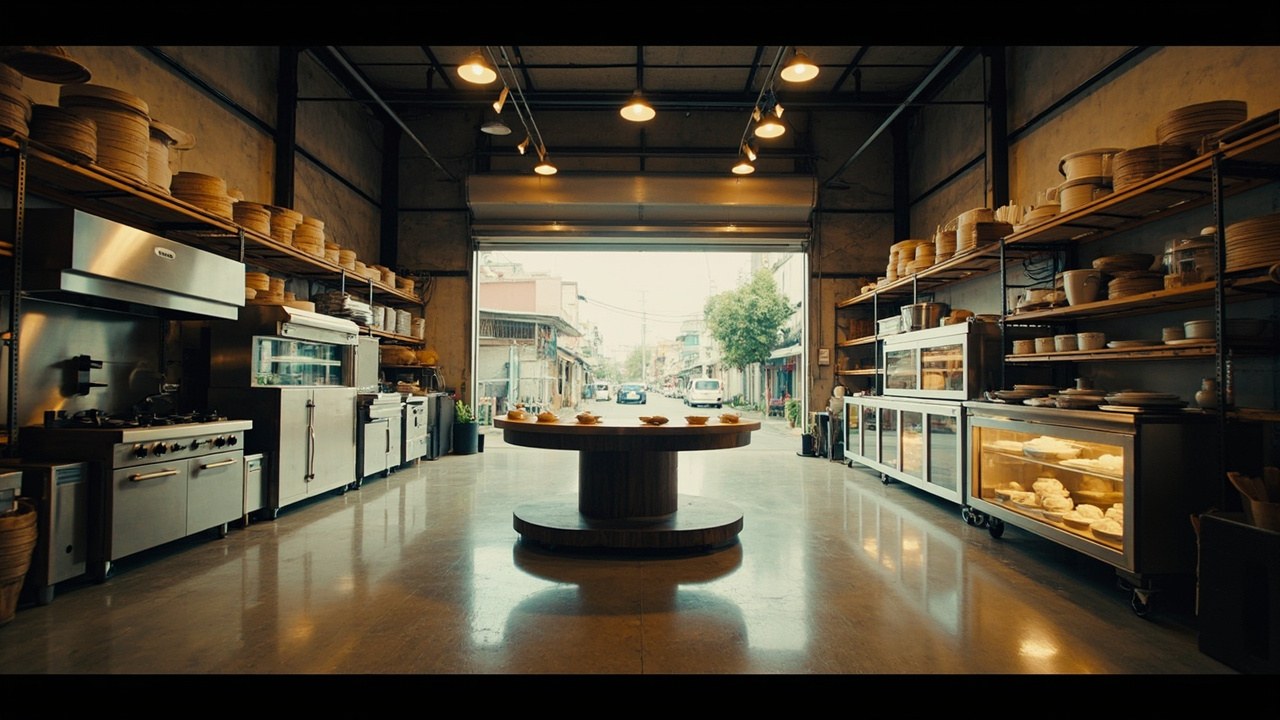
TL;DR Pan, a kitchen-supply entrepreneur from Zigong, Sichuan, spent $280K and one full year of market research to open a 1,200 sqm wholesale warehouse-store on 450 Year Road in Vientiane, Laos. By cutting out importers and wholesalers, he undercuts local competitors by 15–20%. His advice to anyone considering the market: budget 60% above your estimate, learn the language before you ship inventory, and forget quick money.
The 1,200 sqm Warehouse Bet: Pan’s Vientiane Store
In Vientiane, on the 450 Year Road — the city’s main artery near the railway station and Dongdok University — there’s a store that looks like nothing else in Laos.
It’s 1,200 square meters of showroom space, packed with everything a restaurant needs to open its doors: steamers, induction cooktops, refrigerated display cases, tables, chairs, dishware, and a custom-designed hotpot-dual-purpose dining table that Pan — the owner — had specially manufactured in China.
Behind the showroom is a 500-square-meter warehouse stacked with container-loads of inventory.
Pan is from Zigong, Sichuan — a city known for its salt history and its spicy food. Before Laos, he ran kitchenware supply businesses in Kunming and Chengdu. He calls his trade “kitchen companion” — everything you need to turn an empty space into a working commercial kitchen.
Two years and $280,000 USD (2 million RMB) later, he has one of the largest Chinese-run kitchen supply operations in the country.
The Numbers: $280K Breakdown of a Vientiane Warehouse
The most valuable part of Pan’s interview isn’t his story — it’s his ledger.
| Item | Cost (RMB) | Notes |
|---|---|---|
| Annual rent (1,200 sqm) | ~300,000 | 450 Year Road, prime location |
| Raw space to finished store | ~500,000 | Iron-sheet shell → full renovation |
| Hard costs before inventory | ~800,000 | |
| Total investment (with inventory) | ~2,000,000 | Ongoing operational capital |
His store was a bare metal shed when he took possession. No walls, no flooring, no glass doors. Every surface, every fixture, every finish was built from scratch.
“If you’re planning to come to Laos with 300,000 or 400,000 RMB and start something meaningful — that era is over. At this point, that amount can’t do much.”
This is a recurring theme across interviews with Chinese entrepreneurs in Laos: the capital threshold has risen. The days of arriving with a few thousand dollars and improvising your way to a business are gone.
The Wholesale Model: Undercutting the Market by 15-20%
Pan’s business model is straightforward: overseas warehouse + wholesale distribution.
His supply chain runs direct from Chinese manufacturers — full containers shipped to his warehouse in Vientiane. By eliminating intermediaries (importers, distributors, wholesalers), he achieves a structural cost advantage.
The price difference is significant:
“Take this refrigerated cabinet. In other stores in Laos, it sells for around 4,800 RMB. Because we work directly with the factory and handle our own logistics, we can sell it for 4,000 RMB — a saving of 800 RMB for the customer.”
For a Chinese restaurant owner setting up in Laos, 800 RMB is a meaningful saving — it’s a full set of tableware, or several induction cooktops, or a month of logistics costs.
The physical showroom adds another advantage over cross-border e-commerce: zero damage risk.
“When you ship from China, if something breaks, it breaks. Here, what you see is what you get. You inspect the item yourself, you know the condition before you pay.”
This combination — wholesale pricing + physical inspection — is powerful in a market where trust in cross-border logistics is still developing.
The Hotpot Table: Product Innovation for a Niche Market
One of Pan’s flagship products reveals how he thinks about the market.
He designed a dual-purpose dining table specifically for Chinese restaurants in Laos. The table looks like a standard round Chinese dining table, but it has a recessed compartment underneath that accommodates a standard induction cooktop.
With the cooktop installed, it’s a hotpot table. Without it, it’s a regular dining table. One piece of furniture, two use cases — critical for restaurants in Laos where space is at a premium.
“We’ve been in this industry long enough to know what restaurant owners actually need. Almost every Chinese restaurant in Laos wants the flexibility to offer hotpot, but they don’t want to dedicate floor space to single-purpose tables.”
He personally visited and ate at approximately 90% of Chinese restaurants in Vientiane — not just as a customer, but as a product researcher. Each meal was reconnaissance: what equipment are they using? What’s missing? What’s breaking?
His customers return the favor by recommending him to new arrivals. In a small market like Vientiane’s Chinese business community, word-of-mouth is the only marketing channel that matters.
The Language Gap: “I Can’t Explain Why Our Products Are Better”
Pan has been in Laos for two years. His customer base is evenly split — 50% Chinese, 50% Lao.
But he still struggles with the local language.
“The worst part is when a Lao customer clearly wants to buy. They’re interested. They’re asking questions. I know our product is better — better quality, better price — but I cannot explain why. The phone translator gives inaccurate results. The meaning gets lost.”
This is not a minor inconvenience. It’s a structural bottleneck.
In Pan’s industry, the difference between a sale and a lost customer often comes down to a single sentence: “This stainless steel is 304 grade, not 201 — it won’t rust in Laos’s humidity.” Or, “This induction cooktop has overload protection — if the voltage fluctuates, it won’t catch fire.”
When you can’t communicate these differentiators, you’re competing on price alone — and price is the easiest thing for competitors to match.
“Some customers really want to buy. If I could just explain one feature, they would place the order immediately. But I can’t get the words out. It drives me crazy.”
His advice to anyone considering Laos: invest in language before you invest in inventory.
Cultural Friction at the Negotiation Table
The difference in bargaining styles between Chinese and Lao customers reveals a subtle cultural dynamic:
| Customer | Price Behavior | Pattern |
|---|---|---|
| Lao buyers | Ask 800,000 RMB → offer 750,000 RMB | Small, reasonable negotiation |
| Chinese buyers | Ask 1,000,000 RMB → offer 400,000 RMB | Deep discount expectation |
Pan runs a wholesale model built on thin margins and high volume. He can’t absorb 60% discounts.
“We understand the habit — Chinese customers haggle everywhere, and they start by testing the seller’s reaction. But wholesale margins don’t leave room for that kind of negotiation. A reasonable profit is necessary to maintain service quality.”
The challenge is that Chinese customers in Laos often carry the domestic expectation that “the listed price is just the starting point for negotiation.” This creates friction in a business model designed for fixed, fair pricing.
The One-Year Scouting Process
Unlike the jump-first-ask-later approach of some entrepreneurs, Pan spent a full year in Laos before opening his store.
He traveled from north to south, visiting every major city and town. He studied the existing distribution channels for kitchen supplies. He mapped out what products were available, at what prices, and through what routes.
Key findings from his research:
- Laos has no specialized trade streets for kitchen supplies — unlike China, where you can find a “kitchen street” or “tableware street”
- The market is fragmented, with small shops carrying narrow selections
- No single store offered one-stop shopping for restaurant equipment
- Prices were inflated by multi-layer distribution (importer → wholesaler → retailer)
His conclusion: a large-format warehouse store with direct-from-factory pricing could capture the entire mid-market in one move.
Key Takeaways for Cross-Border Entrepreneurs
Capital requirements have risen — The “show up with $5,000 and figure it out” era in Laos is over. Pan recommends budgeting at least 60% above your initial estimate.
Language is a hard ceiling on growth — Without local language proficiency, you can’t communicate product differentiation, which means you compete on price alone. Invest in language training before you invest in inventory.
Physical showrooms win in low-trust markets — Cross-border shipping with damage risk creates demand for “see before you buy” retail. This is a competitive advantage that online-only sellers can’t replicate.
Market research takes longer than you think — Pan spent one full year on the ground before committing. His research revealed a structural gap (no one-stop shop) that a faster, less thorough approach would have missed.
Product localization creates defensible niches — His dual-purpose hotpot table is a minor innovation, but it addresses a specific need in the Laos market that general Chinese suppliers don’t think about.
Wholesale pricing demands cultural adaptation — The Chinese haggling habit doesn’t fit a thin-margin model. Clear pricing communication and customer education are necessary.
Two Stories, One Market
This is the second profile in an informal series on Chinese entrepreneurs in Laos. The first — a Shenzhen University graduate’s menswear store in Laos with a five-month payback claim — captured the velocity of Chinese entrepreneurship.
Pan’s story captures the depth.
One is speed. The other is fundamentals. Together, they paint a complete picture of what it takes to build a serious business in a market that’s small, overlooked, and demanding in ways that aren’t obvious from a distance.
Built a cross-border wholesale or retail operation in Southeast Asia? What market gaps did you identify that others missed? Reach out via the About page — we would like to hear your story.
About the MailMiner Editorial Team
The MailMiner Editorial Team is a group of cross-border e-commerce operators, TikTok Shop sellers, and AI tooling builders. We publish case studies drawn from real seller interviews and our own product experiments — never generic theory, never fabricated case studies.
Our focus areas include cross-border wholesale, overseas warehouse models, Southeast Asia expansion, and solo-operator playbooks. Past coverage includes a Shenzhen University graduate’s menswear store in Laos, the Amazon refined-selection 90% framework, and the keyboard riser niche TikTok hustle.
Disclosure: All figures — the $280K investment, 1,200 sqm showroom, 500 sqm warehouse, 15–20% pricing undercut, and 90% customer-visitation pattern — are reported from the interview with the entrepreneur, not independently audited. Margin and payback figures are not disclosed in the original source.
Have questions about the wholesale + showroom model or want to share a Southeast Asia case study? Reach out via the About page — we read every message.