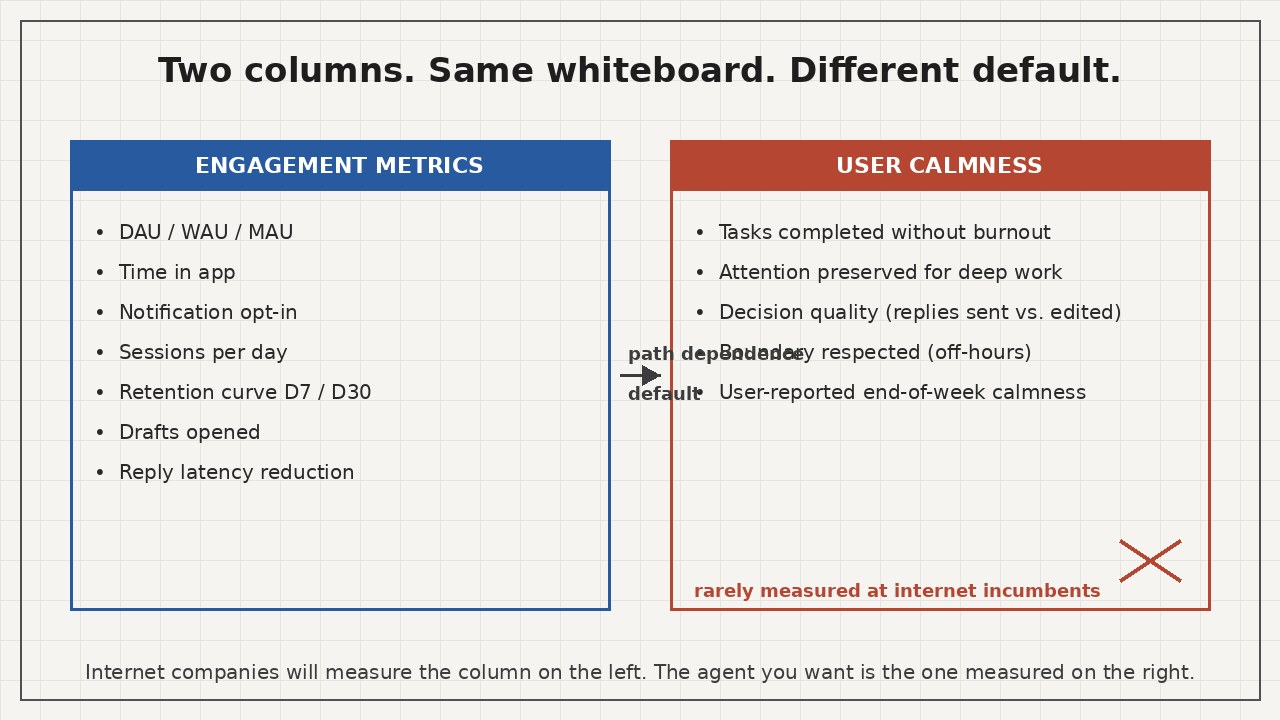
Two-column whiteboard sketch: left column 'engagement metrics' (DAU, time-in-app, notification opt-in) with arrows pointing right; right column 'user calmness' (tasks completed, attention preserved, decision quality) with a single X marking 'path dependence'

Internet Companies Will Design AI Agents the Way They Designed Feeds: Path Dependence in Agent Product Design

TL;DR A few weeks ago I wrote about the structural shape of inbox-native agents vs. Chrome extensions. That post asked what shapes of agent exist and which one fits which workload. This post asks a different question: who is building these agents, and what organizational baggage will they ship by default? My answer, after a half-year running two agent products in production next to incumbents in the same space, is uncomfortable: internet companies will design AI agents the way they designed feeds — open loops, growth metrics, attention capture — because the org, the dashboards, and the muscle memory are the same. The agent you want (calm, draft-only, guardrail-first) is the one built by a team that was never paid to capture your attention. The agent you will be offered is the one built by a team that always was. The difference is not the technology. The difference is the org chart. ...


Laptop showing email inbox with drafted AI reply, with Chrome sidebar extension overlay for cross-border sourcing research

Inbox-Native Agent vs Chrome Extension: When to Build Which

TL;DR I built a Chrome extension for cross-border sourcing, then built an inbox-native AI agent next to it. After 6 months running both in production, the Chrome extension wins for real-time page-anchored research (the 45-second sidebar loop), and the inbox agent wins for relationship-driven work (the 5-year email memory data flywheel). The pattern: the extension is the daytime tool, the inbox agent is the always-on tool. If you build only one, build the inbox agent first — its value compounds with every email it reads. ...

Google I/O 2026: Why 'Fast and Cheap' Beats 'Top Tier' in the AI Race

At Google I/O 2026, something interesting happened. While competitors raced to announce the next benchmark-breaking monster model, Google went the other direction: Gemini 3.5 Flash, positioned as fast and cheap. No claims of topping the leaderboard. No breathless “we超越 GPT-5” messaging. That raised some eyebrows. Was Google concedes defeat? Giving up on frontier research? No. It was the most strategically coherent move of the conference. And if you’re building AI products in 2026, you should be paying very close attention. ...

Pet supplies shop in Barcelona with tablet showing AI chat in Spanish

AI in Cross-Border Trade: A Barcelona Pet Store Story

TL;DR A Chinese cross-border trade practitioner walked into a Barcelona pet store and discovered that the owner’s screen was full of conversations in perfect Spanish — not from multilingual sales reps, but from AI Mai Kou, an AI sales assistant embedded in the Made-in-China.com B2B platform. The story is a microcosm of how AI and short-video channels are quietly rewriting the rules of international trade for small and medium suppliers. A Chinese Trade Practitioner in Barcelona: The Cold Visit The Barcelona sun was warm on the street when he pushed open the door of a small pet supplies shop. It was a cold visit — no appointment, no introduction. Just a Chinese foreign trade practitioner walking into a random store on a random street, hoping for a conversation. ...

DeepSeek-Reasonix: What a Cache-First Architecture Actually Looks Like

Recap: The Cache Mismatch Problem In our previous post, we explained why pairing OpenCode / ClaudeCode with DeepSeek destroys your cache hit rate: DeepSeek uses strict full-prefix matching — a cache hit only fires when every byte from position 0 is identical to the previous request. Agent loops insert tool messages in the middle of the message array, breaking the prefix hash every turn. Anthropic-style cache_control segment markers are silently ignored. Result: near-zero cache hit rate, even though DeepSeek’s billing dashboard shows caching is “enabled.” The problem is not DeepSeek. The problem is that generic agent frameworks were designed for a fundamentally different caching mechanic. ...

Caveman Mode: When Less Output Means More Efficiency

The Problem Nobody Talks About Every engineering team I’ve talked to in the past six months shares the same frustration: AI coding assistants are great, until you look at the bill. Let me give you a concrete example. We ran a React development task through a standard AI assistant setup. The task: implement a feature with proper error handling. The result? 20 minutes and 50,300 tokens consumed. For a single feature. In production, this compounds fast—multiplied across a team of ten engineers running dozens of sessions daily, you’re looking at serious API costs bleeding into your compute budget. ...

Every Enterprise Needs an LLM Gateway: Why API Key Management Is the New Router Problem

The Security Audit That Should Terrify You A security researcher recently scanned 900 publicly accessible configuration files on GitHub. Within minutes, they found 41 valid, active cloud service API keys — keys that granted immediate, unauthenticated access to production servers. No brute force, no social engineering. Just a simple git grep across misconfigured repos. This is not a hypothetical vulnerability. This is happening right now, at scale, across thousands of organizations. ...

How a Solo Developer Reached TikTok US T3: Product Selection Meets AI Automation

The Solo Seller Who Broke the Mold A few weeks ago, I spoke with a TikTok seller who changed how I think about e-commerce automation. He’s a solo operator. One person. In a single month, he hit T3 — the top seller tier on TikTok US — managing达人 outreach, short video production, shipping, and customer support entirely by himself. His background? A programmer who systematically applied software engineering principles to every aspect of his TikTok business. After hearing his workflow, I can confidently say he’s operating at a level above 90% of TikTok merchants on the platform. ...

Why ClaudeCode / OpenCode + DeepSeek Cannot Unlock DeepSeek's Ultra-Low Cache Discounts

Introduction DeepSeek’s disk-based automatic context caching is famous for near 90% input token savings: cached prefix tokens cost just a tiny fraction of standard input pricing, with zero manual configuration required. Thousands of developers switch to DeepSeek chasing this aggressive discount for long system prompts, code rules, and repeated tool definitions. But a costly reality hits teams running ClaudeCode / OpenCode (code agent runtimes built for Anthropic-style cache_control) against the DeepSeek API: ...